Modern gutter-vacuum systems allow professionals to remove leaves, moss and compacted debris from many rooflines while working at ground level. For houses, commercial premises and buildings with awkward access, Jet Power Pressure Washing can provide a safe and efficient alternative to moving ladders repeatedly around a property.
But what is gutter vacuum cleaning, how does it work, and can it clear every blockage? This guide explains the process, its benefits and its limitations for property owners across Cornwall and Devon.
What is gutter vacuum cleaning?
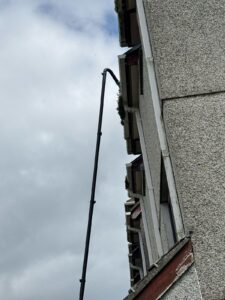
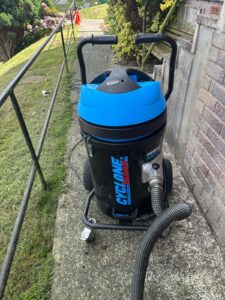
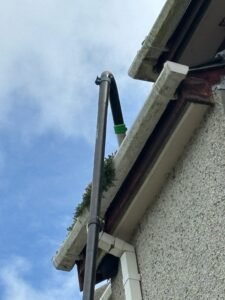
Gutter vacuum cleaning uses a powerful vacuum unit connected to lightweight high-reach poles. The operator guides a shaped attachment through the gutter channel, drawing debris down the poles into a collection drum.
Depending on the equipment and site, the system can remove:
- Fallen leaves.
- Loose and compacted roof moss.
- Twigs and small organic debris.
- Silt and decomposed material.
- Standing water mixed with debris.
- Material gathered around accessible outlets.
The aim is gutter clearance: restoring space within the channel so rainwater can reach the outlets and downpipes.
This is different from washing the outside face of the gutter. Exterior gutter, soffit and fascia cleaning improves appearance, while internal clearance supports drainage. The two services can be combined, but they should not be confused.
How does the process work?
A professional visit normally begins with an assessment of the building, access and gutter layout. Conservatories, extensions, narrow passageways, overhead obstructions and fragile surfaces all affect the method.
The poles are assembled to the required height and connected to the vacuum. A suitable nozzle is then moved along the channel. Dislodged material is drawn into the drum for controlled disposal.
Camera equipment may be used to view sections that cannot be seen from the ground. It can help identify heavy accumulation and confirm the condition after clearance, although visibility depends on the building and weather.
The operator should also consider downpipe outlets. A clear channel is of limited value if water cannot enter or pass through the downpipe.
What are the main advantages?
Ground-based operation
The greatest benefit is the ability to clear many gutters without routinely working from ladders. This reduces the need to repeatedly reposition access equipment and can make it possible to reach over some extensions and conservatories.
Ground-based equipment does not eliminate every risk. Operators still need to manage poles, electrical equipment, pedestrians, vehicles and surrounding property correctly.
High-level reach
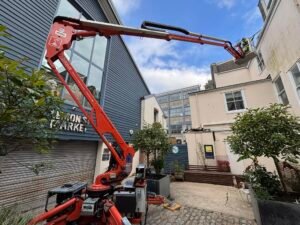
Professional systems can reach gutters above many two- and three-storey buildings. Jet Power Pressure Washing advertises high-reach equipment capable of accessing gutters up to 15 metres, subject to site conditions.
This can be useful for town houses in Plymouth and Truro, commercial premises in St Austell, and taller residential or hospitality buildings across Cornwall and Devon.
Controlled debris collection
Material is drawn into a collection drum instead of being thrown onto paths, gardens or neighbouring property. That helps keep the working area tidy.
Access around obstacles
Some gutters above conservatories, extensions and sloping ground can be difficult to reach using conventional methods. Long poles may allow access from a safer position, although every obstruction must be assessed individually.
Inspection support
A camera can help show what is inside the gutter and highlight sections that need further attention. This is valuable where the channel is invisible from ground level.
Can a gutter vacuum remove all blockages?
No single method is suitable for every situation.
A vacuum is highly effective for loose organic material and many compacted deposits. However, a blockage may be located inside an inaccessible downpipe bend, behind a fixed guard or within underground drainage.
Large objects, securely rooted plant growth, roofing materials and damaged components may require different access or specialist repair work.
If water continues to overflow after the gutter has been cleared, possible causes include:
- A blocked or damaged downpipe.
- Incorrect gutter fall.
- Cracked or displaced joints.
- Insufficient gutter capacity.
- A blocked ground-level drain.
- Defective roof drainage design.
Professional assessment should distinguish between a cleaning problem and a repair or drainage issue.
Is gutter vacuuming better than traditional cleaning?
The best method depends on the property.
Manual clearance can provide direct access where a ladder or platform can be positioned safely. Vacuum cleaning offers advantages where height, obstacles and the need for efficient debris collection make ground-based work suitable.
A professional contractor may need more than one technique. The sensible question is not which method is universally “best”, but which method clears the system safely and thoroughly at the particular site.
For homes in Falmouth, Looe, Newquay and St Ives, access can be influenced by steep streets, attached properties, extensions and coastal exposure. A pre-work assessment is therefore important.
What happens to the debris?
Leaves, moss and silt collected by the machine remain in the vacuum drum. The contents can then be removed from the working area and handled appropriately.
Debris should not simply be pushed into the downpipe. That may transfer the blockage to a less accessible part of the system.
If material contains unexpected contamination or hazardous waste, different handling requirements may apply, particularly on commercial or industrial sites.
Can gutter vacuums clean downpipes?
They can often clear debris around accessible outlets and may assist with some downpipe blockages. However, the shape, length and condition of the pipe determine what is possible.
A blockage deep within a pipe, behind tight bends or beneath ground level may require additional tools or a drainage specialist.
Tell the contractor if water escapes from downpipe joints, the pipe makes unusual noises or a connected gully is overflowing. These details help define the likely scope.
Is gutter vacuum cleaning suitable for commercial buildings?
It can be, particularly for offices, schools, shops, hotels, holiday parks and residential blocks with accessible rooflines.
Commercial properties should be assessed for:
- Roof height and total gutter length.
- Pedestrian and vehicle management.
- Fragile surfaces and overhead hazards.
- Production, customer or teaching hours.
- Waste-handling requirements.
- Documentation and photographic reporting.
- Whether access equipment is still required.
A planned maintenance programme can make scheduling easier and reduce the likelihood of reactive work during heavy rain.
How frequently should gutter vacuuming be booked?
Many properties benefit from annual gutter clearance. Twice-yearly visits may be appropriate near trees, on mossy roofs or where drainage failure would have serious consequences.
Autumn is a common time because of leaf fall, while a spring visit can remove debris left by winter weather. The correct interval should be adjusted according to what is found at each clean.
Properties in Bodmin, Lostwithiel, Launceston and Wadebridge surrounded by mature vegetation may need closer monitoring than buildings without nearby trees.
What should be included in a quotation?
Ask the contractor to confirm:
- Which elevations and gutter sections are included.
- Whether downpipe outlets will be checked.
- The maximum working height.
- How difficult access areas will be handled.
- Whether photos are available.
- How collected debris will be managed.
- Whether external gutter washing is included or separate.
- What happens if damaged fittings are discovered.
Clear scope prevents confusion between internal gutter clearance, downpipe unblocking and exterior roofline washing.
Why choose Jet Power Pressure Washing?
Jet Power Pressure Washing provides residential and commercial gutter cleaning across Cornwall and Devon using industrial-grade, high-reach gutter-vacuum equipment. We are fully insured and can also provide soffit and fascia cleaning to improve the appearance of the roofline.
Read about our gutter cleaning service or explore our wider exterior cleaning services.
Our service area includes Barnstaple, Bodmin, Falmouth, Launceston, Looe, Lostwithiel, Newquay, Padstow, Plymouth, St Austell, St Ives, Truro and Wadebridge, as well as surrounding communities across Cornwall and Devon.
Frequently asked questions
Can gutter vacuuming reach over a conservatory?
Often, yes, but reach depends on the conservatory’s depth, the roofline height and safe positioning around the property.
Will the vacuum clean the outside of my gutters?
Not as part of internal clearance unless exterior washing is specifically included. Ask about combining gutter clearance with soffit and fascia cleaning.
Do I need to be home?
Usually not, provided the team has agreed access around the exterior and any required services are available.
Can wet moss be vacuumed?
Professional wet-and-dry systems are designed to collect wet organic debris, although very compacted material may need to be loosened.
Will you identify damaged gutters?
Obvious defects may be noted during the work, but gutter cleaning is not a structural survey. Repairs should be separately assessed and agreed.
Request a free quote
For professional gutter vacuum cleaning in Cornwall or Devon, request your free quote, call 01503 635 536, or email team@jetpowerpressurewashing.co.uk.uum cleaning in Cornwall or Dev