Many homeowners believe pressure washing automatically damages surfaces, but the truth is more nuanced. Industrial-grade equipment, when used correctly with eco-friendly products, delivers superior cleaning without harming your property. In Cornwall and Devon, where coastal conditions create stubborn algae and grime, the right tools make all the difference. This guide explains how professional equipment transforms exterior cleaning outcomes, protects delicate surfaces, and supports environmental sustainability for your home or commercial property.
Table of Contents
- Key takeaways
- Industrial-grade pressure washers versus residential units
- Specialised tools and cleaning methodologies for exterior surfaces
- Environmental considerations and efficiency benefits of modern equipment
- Avoiding damage: best practices for sensitive exteriors in Cornwall and Devon
- Professional exterior cleaning services in Cornwall and Devon
- Frequently asked questions
Key Takeaways
| Point | Details |
|---|---|
| Industrial grade power | Industrial grade pressure washers deliver higher PSI and higher GPM, enabling thorough exterior cleaning without excessive passes. |
| Soft washing approach | Soft washing uses low pressure to protect delicate surfaces such as roofs and timber while still removing grime and biological growth. |
| Eco friendly detergents | Eco friendly detergents minimise environmental impact when used with efficient machines and correct cleaning techniques. |
| Surface cleaners benefit | Surface cleaners provide even water distribution for streak free results on flat surfaces like patios and driveways. |
Industrial-grade pressure washers versus residential units
Pressure washing effectiveness depends heavily on PSI (pounds per square inch), the force that dislodges dirt and grime. Residential pressure washers typically operate between 1500 and 3000 PSI, suitable for light cleaning tasks like garden furniture or small patios. Industrial-grade pressure washers deliver 3000-4000+ PSI with hot water capabilities, making them far more effective for deep exterior cleaning on building facades, concrete driveways, and heavily soiled surfaces.
Beyond raw pressure, industrial units offer crucial features that residential models lack. Hot water reaching 200°F dissolves grease, oil stains, and biological growth like algae that thrives in Cornwall’s humid coastal climate. Higher GPM (gallons per minute) ratings, often 4-8 GPM compared to residential 1.5-3 GPM, mean industrial washers cover larger areas faster whilst maintaining consistent cleaning power. This combination removes graffiti, years of accumulated grime, and stubborn moss that residential equipment simply cannot shift.
The performance gap becomes obvious on challenging surfaces. Building exteriors with ingrained pollution, concrete driveways with oil stains, or commercial patios with heavy foot traffic require industrial power for thorough restoration. Residential units struggle with these tasks, forcing users to make multiple passes that waste time and water. Homeowners attempting large projects with underpowered equipment often abandon the job halfway through or achieve patchy, unsatisfactory results.
Using residential equipment on heavily soiled areas creates false economy. The prolonged cleaning time increases water consumption, and repeated attempts damage surfaces through excessive scrubbing or prolonged exposure to cleaning chemicals. Understanding pressure washing fundamentals helps property owners recognise when professional-grade tools become necessary. Commercial property managers especially benefit from industrial equipment’s efficiency, completing maintenance schedules without disrupting operations.
Pro Tip: If your cleaning project involves surfaces over 100 square metres, multiple storeys, or stubborn stains that household cleaners cannot remove, industrial-grade equipment will save time and deliver superior results. Many common pressure washing myths stem from using inappropriate equipment for the task at hand.
| Equipment type | PSI range | GPM range | Hot water | Best applications |
|---|---|---|---|---|
| Residential | 1500-3000 | 1.5-3 | Rarely | Garden furniture, small patios, vehicles |
| Industrial | 3000-4000+ | 4-8 | Yes | Building exteriors, large driveways, commercial spaces, heavy grime |
Key advantages of industrial equipment:
- Removes biological growth (algae, moss, lichen) in single pass
- Hot water capability dissolves oil and grease effectively
- Higher GPM covers large areas without pressure loss
- Durable construction withstands daily commercial use
- Adjustable pressure settings protect delicate surfaces when needed
Specialised tools and cleaning methodologies for exterior surfaces
Surface cleaners with spinning nozzles deliver streak-free cleaning efficiently on flat surfaces by distributing water pressure evenly across the cleaning path. These attachments connect to pressure washers and feature rotating bars with multiple jets enclosed in a circular housing. The spinning action eliminates zebra striping that occurs when using a standard wand on driveways or patios. Proper sizing matters: a 4 GPM machine requires a 16-18 inch surface cleaner, whilst 8 GPM units work best with 24-30 inch models.
Soft washing represents the opposite approach, using minimal pressure to protect vulnerable materials. Pre-treatment with eco-friendly detergents and low-pressure application (30-100 PSI) protects delicate surfaces such as roofs and wood decking whilst still removing dirt and organic growth. The cleaning solution does the work, breaking down contaminants chemically rather than blasting them away with force. Wood decking tolerates slightly higher pressure, around 1200-1500 PSI, but still requires careful technique to avoid splintering or grain raising.
Professional exterior cleaning services follow a systematic methodology that maximises results whilst minimising surface damage. The process begins with pre-treatment using biodegradable detergents formulated for specific contaminants. These solutions dwell for 10-15 minutes, penetrating and loosening grime. Soft washing follows, applying cleaning agents at low pressure to saturated surfaces. Finally, a high-pressure rinse removes all residue, working from top to bottom to prevent streaking and ensure complete cleaning.
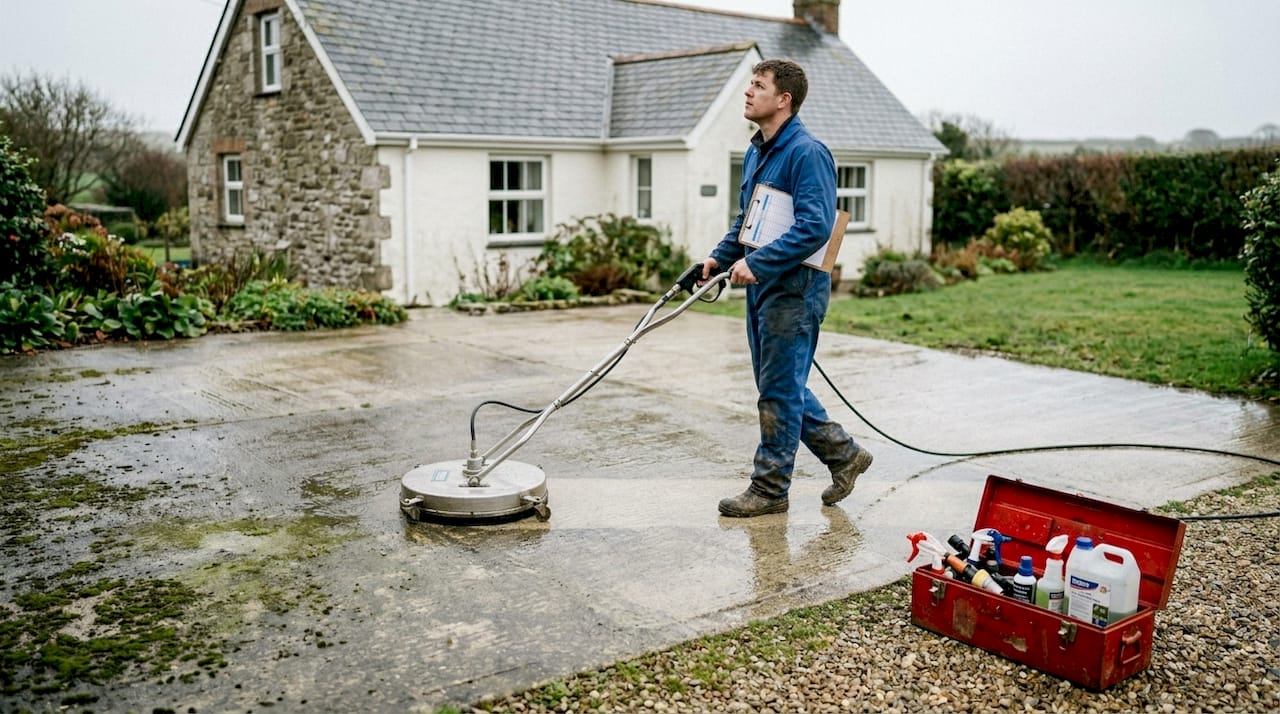
Nozzle selection and cleaning distance determine whether you achieve brilliant results or cause expensive damage. Zero-degree nozzles concentrate water into a pencil-thin stream capable of etching concrete or stripping paint. The 25-degree green nozzle suits most general cleaning, whilst 40-degree white nozzles work best for delicate surfaces. Maintaining proper distance, typically 12-18 inches from the surface, prevents damage whilst ensuring effective cleaning. Moving too close increases impact force exponentially, even with wider spray patterns.
Pro Tip: Always test your pressure and technique on an inconspicuous area before tackling visible surfaces. What works on concrete may destroy wood, render, or painted surfaces. Safe decking pressure washing requires particular attention to grain direction and moisture content.
| Surface type | Recommended PSI | Nozzle angle | Distance | Pre-treatment |
|---|---|---|---|---|
| Concrete/brick | 3000-3500 | 15-25° | 12-18 inches | Degreaser for oil stains |
| Render/painted surfaces | 1500-2000 | 25-40° | 18-24 inches | Mild detergent |
| Wood decking | 1200-1500 | 25-40° | 12-18 inches | Wood-safe cleaner |
| Roof tiles | 30-100 | 40-65° | 24-36 inches | Algaecide/moss killer |
| UPVC/composite | 1500-2000 | 25-40° | 18-24 inches | General purpose cleaner |
Essential specialised equipment:
- Telescopic wands for reaching high areas safely
- Turbo nozzles for concentrated cleaning power
- Chemical injectors for consistent detergent application
- Gutter cleaning attachments for debris removal
- Undercarriage cleaners for vehicle washing
Environmental considerations and efficiency benefits of modern equipment
Eco-friendly detergents have revolutionised exterior cleaning by delivering powerful results without harming plants, pets, or waterways. Biodegradable formulas break down naturally within days, unlike traditional harsh chemicals that persist in soil and groundwater. Green Seal certified products meet rigorous environmental standards whilst effectively removing dirt, algae, and organic stains. These solutions work particularly well in Cornwall and Devon, where proximity to coastlines and protected natural areas demands responsible cleaning practices.
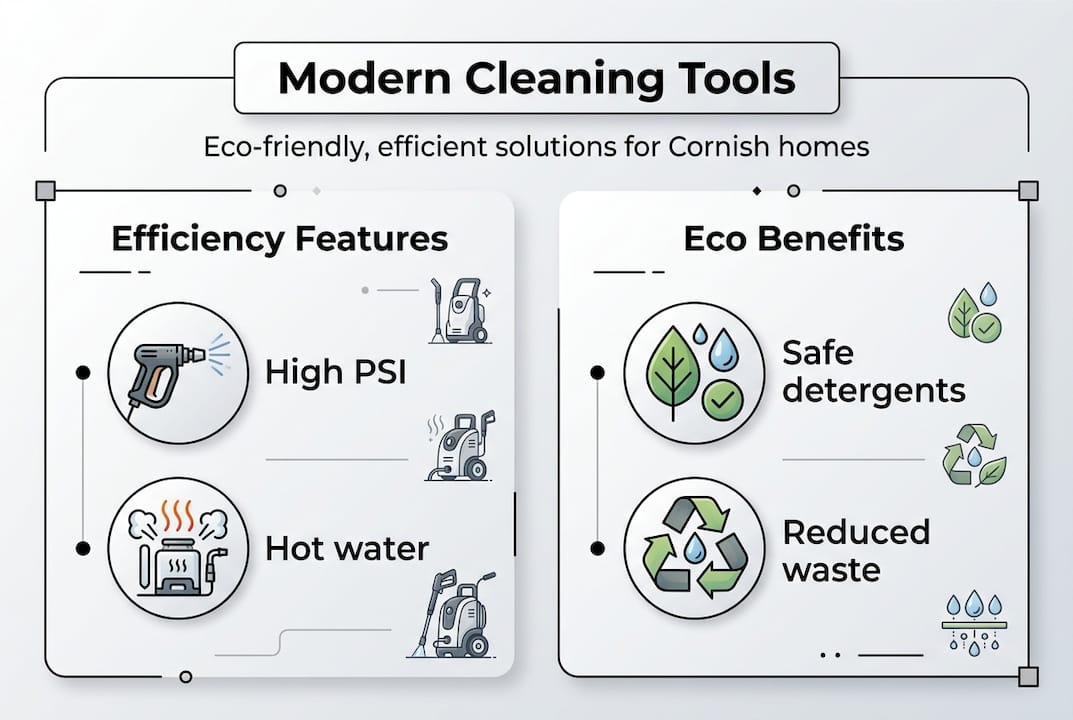
Energy-efficient industrial equipment reduces environmental impact through multiple mechanisms. Modern machines recycle water, capturing and filtering runoff for reuse during extended cleaning sessions. Variable-speed motors adjust power consumption based on cleaning requirements, reducing electricity use during lighter tasks. Advanced cleaning equipment reduces water use by 40% and cuts cleaning times by one third, translating to thousands of pounds in annual savings for property managers whilst conserving precious resources.
The financial benefits extend beyond water and energy savings. Efficient equipment completes jobs faster, reducing labour costs and property downtime. Commercial facilities can schedule cleaning during off-peak hours without extending into business operations. Residential properties benefit from shorter disruption periods and lower service costs. The combination of speed and thoroughness means surfaces stay cleaner longer, reducing the frequency of maintenance cleaning and extending the intervals between deep cleaning sessions.
Professional power washing with sustainable practices protects Cornwall and Devon’s unique coastal ecosystems whilst maintaining property value. Eco-friendly detergents and water-efficient equipment demonstrate environmental responsibility without compromising cleaning quality.
Industrial cleaning equipment benefits extend to workplace safety and regulatory compliance. Reduced chemical exposure protects cleaning staff and building occupants. Lower water volumes minimise slip hazards during and after cleaning. Modern equipment meets stringent environmental regulations, helping property owners avoid fines and maintain certifications. For Cornwall and Devon properties, especially those near protected marine environments, these considerations carry particular weight.
| Efficiency metric | Traditional equipment | Modern eco-efficient equipment | Annual savings (typical commercial property) |
|---|---|---|---|
| Water consumption | 100% baseline | 60% of baseline | £2,400 |
| Cleaning time | 100% baseline | 67% of baseline | £3,600 in labour |
| Chemical use | 100% baseline | 40% of baseline | £800 |
| Energy consumption | 100% baseline | 75% of baseline | £600 |
Practical environmental advantages:
- Biodegradable detergents protect lawns, gardens, and local waterways
- Reduced water consumption conserves resources in drought-prone periods
- Lower chemical volumes minimise environmental footprint
- Energy-efficient motors reduce carbon emissions
- Longer equipment lifespan reduces manufacturing waste
Avoiding damage: best practices for sensitive exteriors in Cornwall and Devon
High PSI can cause splintering, seal damage, or paint stripping especially on wood, composite decking, and caravans when operators use inappropriate pressure or incorrect nozzle angles. The concentrated force of water under extreme pressure acts like thousands of tiny hammers, breaking molecular bonds in paint, forcing water beneath protective seals, and tearing wood fibres from their cellular structure. These problems compound over time, as initial minor damage creates entry points for moisture, accelerating rot and deterioration.
Wood surfaces demand particular caution because grain patterns create natural weak points. Pressure washing across the grain lifts fibres, creating a rough, splintered texture that traps dirt and moisture. Softwoods like pine suffer more damage than hardwoods, but both require reduced pressure and careful technique. Composite decking, despite its durability, can delaminate when water penetrates the protective cap layer. Caravans present multiple vulnerable areas: rubber seals around windows and doors, aluminium panels that dent under concentrated pressure, and graphics that peel when blasted directly.
Thirty percent of caravan owners report damage from pressure washing, highlighting the need for calibrated equipment and expert techniques. Many assume that more pressure equals better cleaning, but this misconception causes thousands of pounds in repair bills annually. Painted surfaces, whether on buildings or vehicles, require PSI levels that clean without stripping. The paint thickness, surface preparation, and age all influence how much pressure the coating can withstand before failing.
Cornwall and Devon’s humid coastal climate creates ideal conditions for moss, algae, and lichen growth. These organisms establish deep root structures that require chemical treatment rather than brute force removal. Attempting to blast biological growth off sensitive surfaces often removes the growth along with the surface itself. The salt-laden air also affects metal components, making them more susceptible to corrosion if protective coatings are damaged during aggressive cleaning.
Pro Tip: Professional cleaners experienced with Cornwall exterior cleaning understand local environmental conditions and adjust their techniques accordingly. The investment in expert service prevents damage that costs far more to repair than the original cleaning would have cost.
Best practices for protecting sensitive surfaces:
-
Assess surface material and condition before selecting pressure settings. Check for existing damage, loose paint, or deteriorated seals that could worsen under pressure.
-
Choose appropriate PSI and nozzle angle for the specific material. Start with lower pressure and wider angles, increasing only if necessary to achieve cleaning goals.
-
Test on a small, hidden area to verify that your chosen settings clean effectively without causing damage. Allow the test area to dry completely before evaluating results.
-
Maintain consistent distance and angle throughout the cleaning process. Avoid lingering in one spot, which concentrates force and increases damage risk.
-
Use eco-friendly detergents formulated for the surface type to reduce the pressure required for effective cleaning. Chemical action replaces mechanical force.
-
Work with the surface grain or pattern rather than against it. This approach minimises fibre raising on wood and reduces streaking on textured surfaces.
-
Rinse thoroughly from top to bottom to prevent detergent residue and dirty water from staining lower areas. Complete rinsing prevents chemical damage to plants and surfaces.
-
Allow adequate drying time before applying sealants or protective coatings. Trapped moisture beneath new finishes leads to premature failure.
Professional exterior cleaning services in Cornwall and Devon
Professional exterior cleaning combines industrial-grade equipment with eco-friendly products and local expertise to deliver results that DIY approaches cannot match. Experienced technicians understand how Cornwall and Devon’s unique coastal environment affects different surfaces, adjusting pressure, temperature, and cleaning solutions accordingly. This knowledge prevents the damage that common pressure washing mistakes cause whilst ensuring thorough removal of algae, salt deposits, and atmospheric pollution.
Our professional cleaning services utilise calibrated equipment matched to each surface type, from delicate render and wood to robust concrete and brick. Full insurance coverage protects your property throughout the cleaning process. The time savings alone justify professional service: what might take a homeowner an entire weekend with rented equipment, professionals complete in hours with superior results. For commercial exterior cleaning, minimising disruption whilst maintaining appearance standards becomes critical to business operations.
Pro Tip: Scheduling professional exterior cleaning annually prevents buildup that becomes progressively harder to remove. Regular maintenance extends surface life, maintains property value, and costs less than neglecting exteriors until restoration becomes necessary.
Frequently asked questions
How do industrial-grade pressure washers differ from household models?
Industrial units deliver 3000-4000+ PSI with hot water capabilities reaching 200°F, enabling them to remove tough grime, oil stains, and biological growth that residential models (1500-3000 PSI) cannot handle. They also feature higher GPM ratings for faster coverage and more durable construction for daily commercial use. This pressure washing practical guide explains when upgrading to professional equipment becomes necessary.
What is soft washing and when should it be used?
Soft washing applies cleaning solutions at 30-100 PSI, using chemical action rather than mechanical force to remove dirt and organic growth from delicate surfaces. This technique protects roofs, wood decking, render, and painted surfaces that high-pressure washing would damage. The benefits of soft washing include longer-lasting results because it kills biological growth at the root rather than just blasting it away.
How does eco-friendly equipment benefit my property and the environment?
Eco-friendly equipment uses biodegradable detergents that break down naturally without harming plants, pets, or waterways whilst reducing water consumption by up to 40% compared to traditional methods. Lower chemical volumes and energy-efficient motors minimise environmental impact whilst cutting operational costs. Our eco-friendly cleaning services demonstrate that environmental responsibility and superior cleaning results work together rather than competing.
Can pressure washing damage my property?
Improper pressure washing absolutely can damage surfaces through excessive PSI, incorrect nozzle angles, or inadequate distance from the surface. Wood splintering, paint stripping, seal damage, and surface etching all result from poor technique or inappropriate equipment selection. Professional services prevent these problems through proper equipment calibration, surface assessment, and experienced application.
How often should exterior surfaces be professionally cleaned?
Most residential properties benefit from annual professional cleaning, whilst commercial properties with high visibility or heavy use may require quarterly or bi-annual service. Cornwall and Devon’s humid coastal climate accelerates algae and moss growth, potentially necessitating more frequent cleaning than inland properties. Regular maintenance prevents buildup that becomes progressively harder and more expensive to remove.